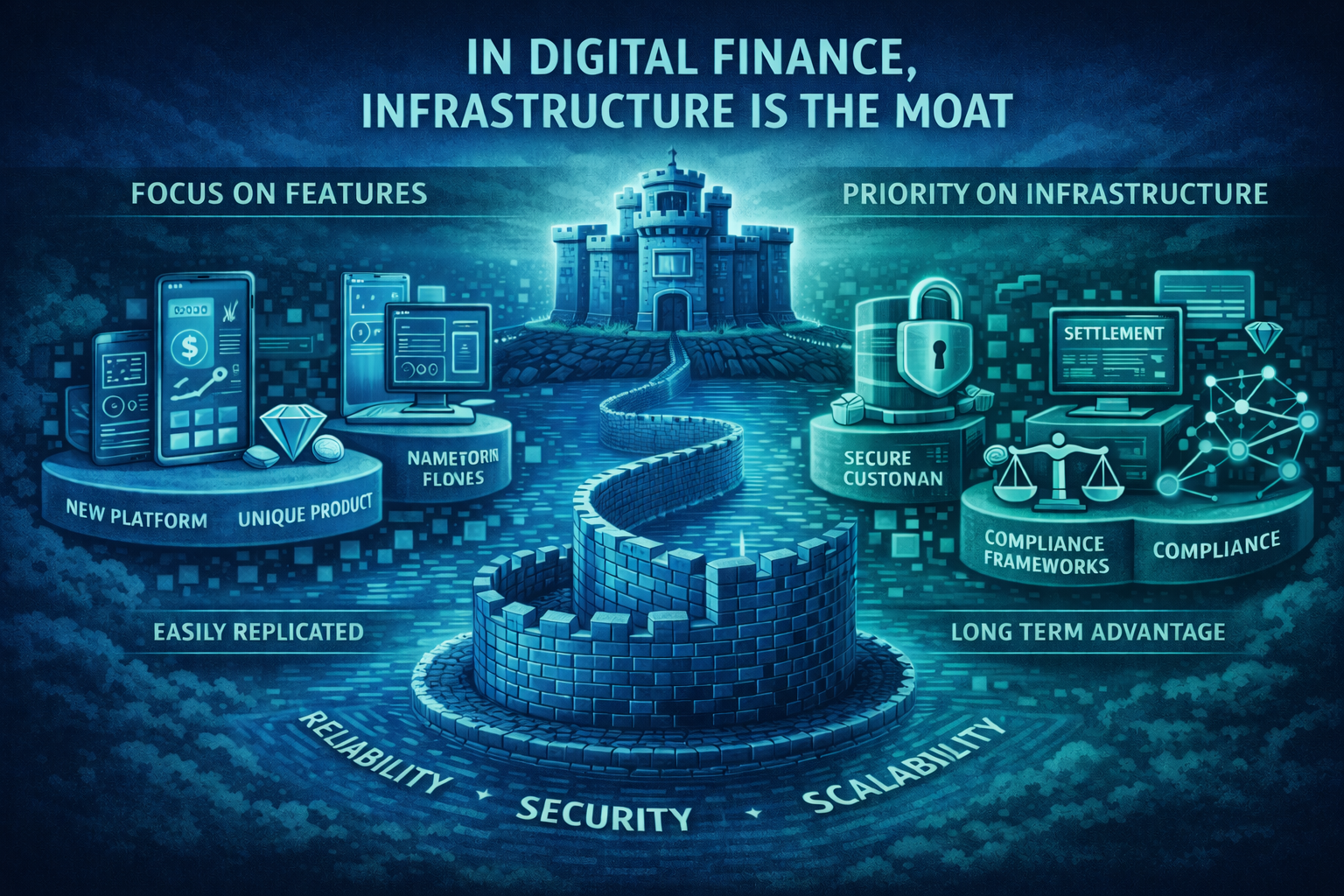
Quick answer: In digital finance, attention often gravitates toward features.
In digital finance, attention often gravitates toward features.
New platforms, new interfaces, and new products are easier to communicate and easier to compare. They create visible differentiation in the short term. However, they are rarely what defines long term advantage.
Infrastructure is.
Infrastructure determines how systems operate behind the scenes. It governs how transactions are processed, how data is structured, and how services scale. While features can be replicated quickly, infrastructure requires time, integration, and alignment with broader systems.
This is why infrastructure creates defensibility.
According to Boston Consulting Group, the next phase of financial innovation will be shaped by underlying systems rather than surface level offerings. Deloitte similarly highlights that scalable infrastructure is critical for tokenization and digital assets to function within regulated environments.
In practical terms, infrastructure includes custody, settlement, compliance frameworks, and system interoperability. These elements are not always visible to end users, but they are essential for reliability and trust.
Building this layer is not simple. It requires long term investment and coordination across multiple stakeholders. It also requires alignment with regulatory standards and existing financial processes.
This complexity is precisely what creates a moat.
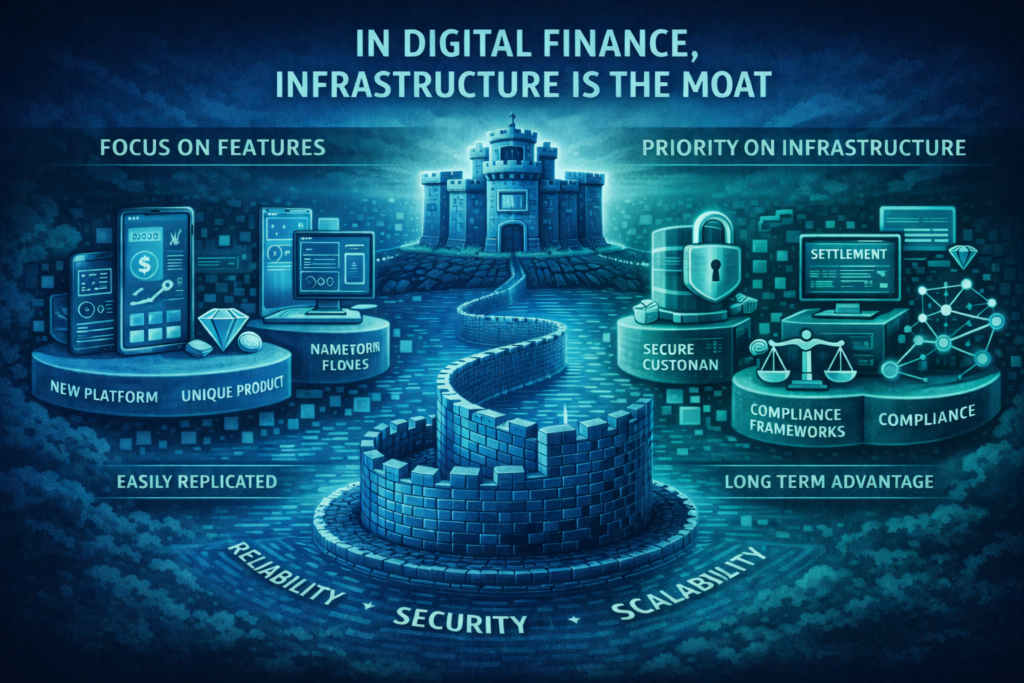
Once infrastructure is established and integrated, it becomes part of how markets function. Replacing it is not just a technical decision. It is an operational and strategic one.
There is also a shift in how value is perceived.
As digital finance matures, the market is placing more emphasis on reliability and execution. Companies that can support consistent performance are more likely to retain relevance than those that rely on continuous feature development.
This does not mean that innovation is less important. It means that innovation needs to be supported by structure.
For companies operating in this space, the priority should be clear. Building infrastructure may not generate immediate attention, but it creates long term positioning.
In digital finance, what matters most is often what is least visible. If you are evaluating opportunities in digital finance, it is worth asking where the infrastructure sits and how it supports long term execution.
Sources
Boston Consulting Group: https://www.bcg.com/publications/2024/china-tokenized-funds-the-third-revolution-in-asset-management-decoded
Deloitte: https://www.deloitte.com/us/en/Industries/financial-services/articles/tokenization-in-financial-services.html
World Economic Forum: https://www.weforum.org/stories/2024/12/tokenization-blockchain-assets-finance/
Disclaimer
The content provided by Spirit Blockchain Capital Inc. is for informational purposes only and does not constitute investment advice, financial advice, or a solicitation to buy or sell any securities. Information presented may include general market commentary and forward-looking statements, which are subject to risks and uncertainties. Actual results may differ materially. While believed to be accurate at the time of publication, no representation or warranty is made as to completeness or accuracy. Readers should conduct their own due diligence and consult professional advisors before making any decisions. Spirit undertakes no obligation to update this information except as required by applicable securities laws.