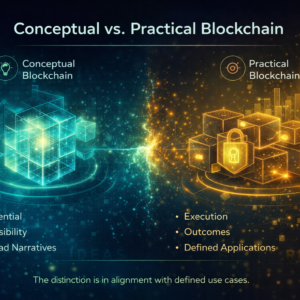
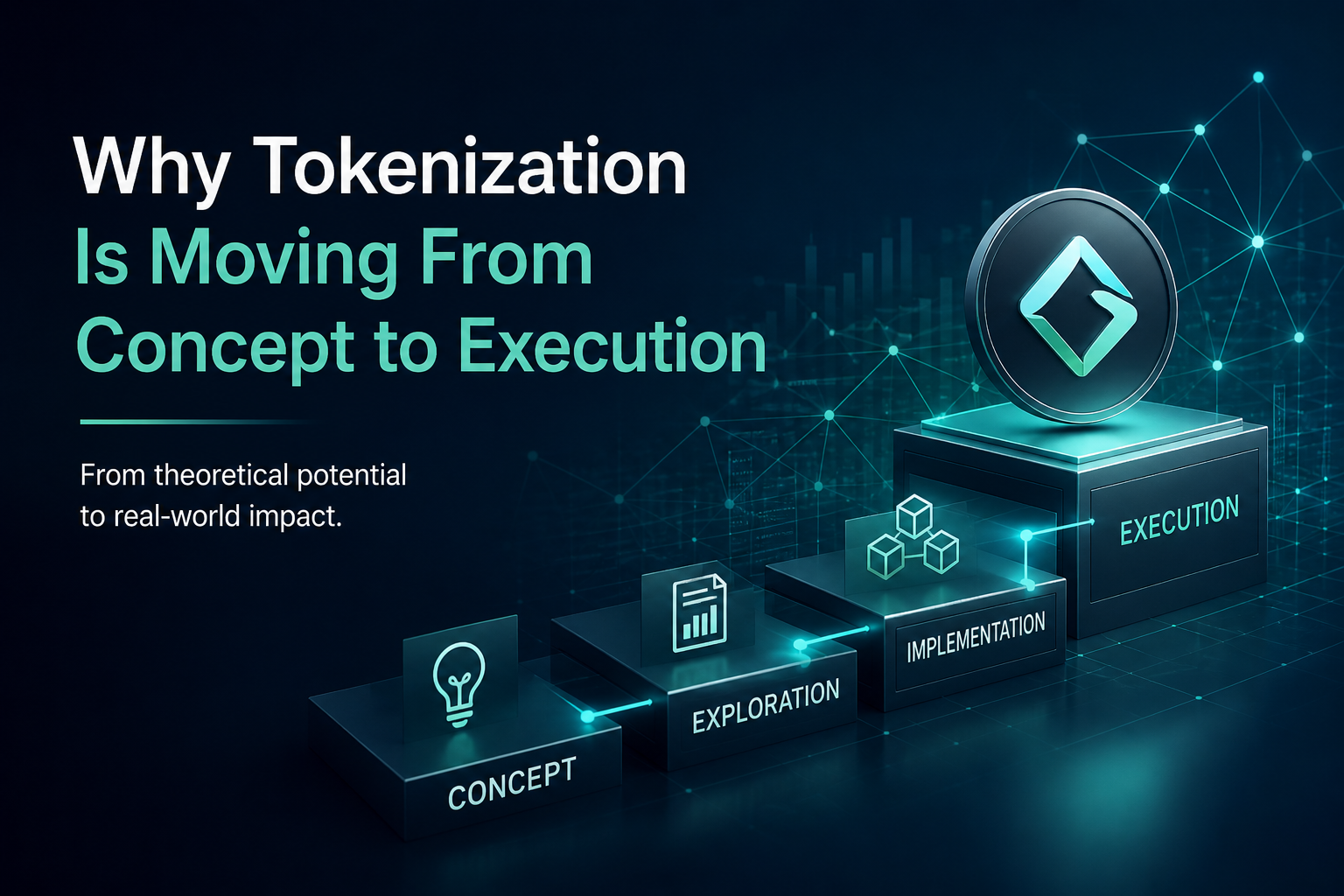
For several years, tokenization has been positioned as a transformative concept within financial markets. It has been discussed in terms of efficiency, access, and modernization. However, much of this discussion remained conceptual, with limited large scale application.
That is now beginning to shift. Tokenization is moving from exploration to implementation. This transition reflects a broader shift in financial markets, where ideas gain relevance only when supported by infrastructure, regulatory alignment, and real use cases.
At its core, tokenization is the process of creating a digital representation of an asset on a distributed system. Its potential lies in improving how assets are issued, transferred, and managed across the financial system.
Recent developments suggest that this potential is starting to materialize. McKinsey notes that tokenization has reached a “tipping point,” with early applications already transacting significant volumes of assets and demonstrating measurable efficiencies.
Similarly, Deloitte highlights that tokenization can enable new financial products, improve liquidity, and streamline operations through programmable systems and shared ledgers.
These developments are important because they shift the focus from narrative to execution.
Markets tend to reward demonstrated outcomes rather than projected benefits. Early positioning can create awareness, but long term relevance is determined by how effectively a concept is applied within real market environments.
Institutional participation reinforces this trend. Large financial institutions are increasingly exploring tokenized models not as standalone innovations, but as extensions of existing infrastructure. Research shows that tokenization platforms are being developed in alignment with regulatory frameworks and integrated into core financial activities such as asset servicing and settlement. This reflects a more pragmatic approach.
Tokenization is not replacing traditional finance. It is being incorporated into it. The most credible implementations are those that improve existing processes while maintaining alignment with regulatory and operational standards.
There is also a growing recognition that adoption will take time.
Regulators have noted that while tokenization has the potential to reshape financial markets, its benefits will vary depending on how it is implemented and how it interacts with existing systems.
This reinforces the importance of discipline. For companies operating in this space, the opportunity is no longer to define tokenization in broad terms. It is to demonstrate where it works, how it integrates, and what value it creates.
As tokenization continues to evolve, its role will be defined by execution. Organizations that focus on practical application, rather than narrative positioning, are more likely to build credibility and participate meaningfully in the next phase of financial infrastructure.
In this context, understanding tokenization as an applied system rather than a conceptual framework provides a more useful starting point for evaluating its relevance within capital markets.
Sources
McKinsey, From Ripples to Waves the Transformational Power of Tokenizing Assets: https://www.mckinsey.com/featured-insights/mckinsey-explainers/what-is-tokenization?; https://www.mckinsey.com/industries/financial-services/our-insights/from-ripples-to-waves-the-transformational-power-of-tokenizing-assets?
Deloitte, Tokenization in Financial Services: https://www.deloitte.com/us/en/industries/financial-services/articles/tokenization-in-financial-services.html?
SagePub: https://journals.sagepub.com/doi/10.1177/10245294261424301?
Reuters, Global Securities Watchdog Says Tokenization Creates New Risks: https://www.reuters.com/sustainability/boards-policy-regulation/global-securities-watchdog-says-tokenization-creates-new-risks-2025-11-11/